By: @Brittney Barsotti
On July 30, the California Air Resources Board (CARB) submitted the final Advanced Clean Fleets (ACF) regulations to the Office of Administrative Law (OAL), which are posted online. The application and scope of the regulations have retained some language from the most recent 15-day draft, stating the regulations apply to any fleets that contract with a state or local government. The inclusion of the contractor language is concerning because this could sweep in private fleets – this issue is discussed more below. This issue is further detailed in CSDA’s 2nd 15-day comment letter which can be viewed here.
CSDA’s repeated request to fully exempt vehicles that support emergency response continues to be denied.
Highlights from the Final Regulations:
- The Milestone and Purchase schedules have been revised and contain timelines based on the type of vehicle.
- The “Fleet Resiliency Exception” is an option for vehicles that support emergency response, but requires 5 Zero Emission Vehicles (ZEVs) in a fleet and a cap of 25 percent of the fleet.
- The Hiring Entity requirements have been retained.
- The regulations still include those who contract with state or local governments, though CARB has described a dispatch limitation in its Final Statement of Reasons, discussed below.
- The regulations also add definitions for waste fleets. It also acknowledges the use of Captive Biofuel Use.
The definitions of fleet and fleet owner include the ambiguous language, “contracts for the operation of.” In the Final Statement of Reasons (FSOR) CARB states that the only contracted vehicles the regulations would apply to are “dispatched” vehicles.
“Dispatch” means to provide direction or instruction for routing a specific vehicle, whether owned or under contract, to specified destinations for specific purposes, including delivering cargo, passengers, property or goods, or providing a service.
While this is at least an attempt to be clearer than the last 15-day comment period draft, it is still unclear how helpful this guidance will be. Contract documentation reporting requirements under the regulations still includes copies of “any agreement contracting for services using vehicles.” This reporting language is far more expansive and significantly more administratively burdensome for state and local governments.
Therefore, while CARB has repeatedly stated these regulations do not apply to private fleets, that remains to be seen. CSDA continues to analyze this issue.
Milestone groups progressively go from the light/medium-duty vehicles to the heavy-duty vehicles. Full compliance is required progressively, with group 1 requiring full compliance by 2035, milestone group 2 by 2039, and milestone group 3 fully compliant by 2042 and beyond.
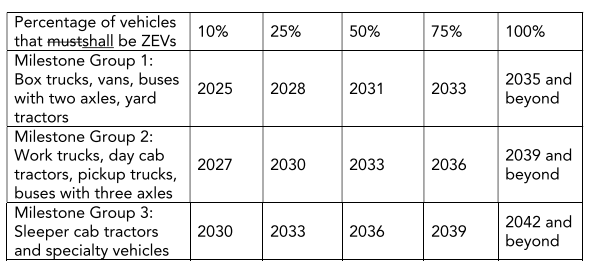
The purchase schedule path to compliance still requires full compliance by 2030 - in order to switch to the milestones pathway or from milestone to purchase pathway, an agency is required to be compliant with its current pathway. The purchase schedule has required 50 percent of purchases be ZEV since 2024.
The final regulations also contain a definition of “good engineering judgment,” which is part of the consideration when granting exemptions that remain at the discretion of the CARB Executive Officer. Good Engineering judgment is defined as using commonly believed scientific and mathematical principles when making a decision, that seeks to maximize public benefit and minimize public harm. This newly added term appears frequently in the exemption sections, since many exemptions are under the decision of the Executive Officer.
There is also a small fleet or low population county exemption:
A state or local government agency that meets any one of the following is excluded from complying with the regulations:
- its jurisdiction is solely in a designated low population county;
- it owns, leases, or operates ten or fewer vehicles in the California fleet, as specified in section 2013(g); or,
- its jurisdiction or service area is split between a designated low population county and a non-designated county and at least 90 percent of the service area in square miles is in the designated low population county.
The wait for the final ACF regulations may be over, but there are still several issues that have not been fully resolved or that continue to be analyzed. CSDA anticipates hosting a webinar to provide more information and share additional information.
Stay tuned to Advocacy News and CSDA eNews for additional updates.
#FeatureNews#AdvocacyNews#EnvironmentResources#Mandates#Public Works and Facilities
#PublicWorksandFacilities