By: @Ophelia Szigeti
Governor Gavin Newsom unveiled his final State Budget May Revision on May 14, 2026, framing the proposal as fiscally responsible and structurally balanced. However, in doing so, he outlined a budget trailer bill proposal that could restrict development related fee revenue that special districts and other local agencies rely on to fund infrastructure needed to support new housing.
Throughout his presentation, Governor Newsom emphasized what he described as California’s economic “dominance,” highlighting the state’s manufacturing strength, agricultural output, and broader economic influence. At the same time, he acknowledged a series of economic challenges facing the state, including inflationary pressures, market instability, and rising costs associated with recent federal actions.
The Governor specifically pointed to federal legislation, H.R.1, which he said has resulted in approximately $1.8 billion in new state costs, including an estimated $1.5 billion increase in Medi-Cal expenditures and an additional $288.1 million in CalFresh costs. The May Revision proposes approximately $334.2 billion for health and human services programs in the 2026–27 fiscal year, including $90.4 billion from the General Fund.
Newsom also addressed rising fuel prices, attributing recent increases in part to geopolitical instability. According to the Governor, inflation and unemployment trends have had an outsized effect on California because of the state’s large and diverse economy, impacting multiple major sectors simultaneously.
New Concern for Special District Infrastructure Funding
The May Revision proposes statutory changes aimed at reducing state costs related to state subsidized affordable housing projects. The development impact fee budget trailer bill proposal would pressure local governments to waive development related fees on state affordable housing programs. It would also bar local governments, when acting as a lead applicant or co-applicant on certain housing projects receiving state funding, from charging development impact fees on those projects as a condition of receiving state funding.
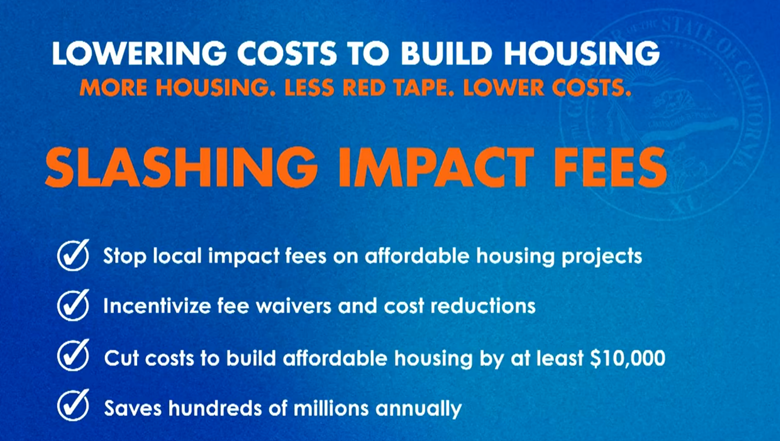 CAPTION: Slide presented by Governor Gavin Newsom at May 14, 2026 May Revise Press Conference in Sacramento.
Protecting access to development related fees, inclusive of development impact fees and other infrastructure costs properly allocated to developers, is a significant focus of CSDA’s ongoing advocacy efforts. Development related fees fund the very infrastructure necessary to provide affordable essential services. Reducing access to such fees results in costs shifted from developers to existing residents, or reduced levels of service needed to protect the health, safety, and wellness of all Californians.
Following release of the May Revision, CSDA Chief Executive Officer Neil McCormick issued a statement regarding potential changes to development related fees that help fund local infrastructure and services:
We look forward to reviewing the details of the Governor’s May Revise concerning developer related fees that fund housing infrastructure,” McCormick said. “If developer fees are cut with no state backfill, it will either deprive new residents of sufficient parks, emergency response and other essential services, or shift the cost burden onto the very Californians we are all trying to help.
As CSDA continues to analyze the Governor’s development impact fee proposal closely, members with input on the proposal and its potential impacts on special districts are encouraged to contact CSDA Legislative Representative Anthony Tannehill at anthonyt@csda.net.
Additional updates on any advocacy efforts will be shared through CSDA’s member communications channels.
General May Revision Highlights
Governor Newsom described the May Revision as a balanced budget proposal for both the 2026–27 and 2027–28 fiscal years. The proposed budget totals $349.9 billion, including $246.6 billion from the General Fund. The Governor also highlighted updated revenue projections, noting that anticipated revenues are now projected to be $16.5 billion higher than estimated in the January budget proposal.
Earlier this year, the Governor released a budget plan aimed at resolving a projected $2.9 billion funding gap for fiscal year 2026–27 while preserving approximately $4.5 billion in discretionary reserves. The Governor’s revision includes $3.6 billion in total solutions in 2026-2027, increasing to $5.1 billion in 2027-2028, with a decrease in 2029-2030 to $4.4 billion. Spending reductions and reforms total $411 million in 2026-2027 and increase to $711.9 million in 2029-2030. General Fund offsets for 2026-2027 are $390.7 million, down to $265.5 million in 2029-2030.
The Governor acknowledged that, while recent revenues have outperformed expectations, the state must remain cautious given California’s ongoing revenue volatility. He referenced updated projections from the Legislative Analyst’s Office (LAO) indicating revenues are significantly higher than anticipated last fall, while cautioning that fluctuations tied to capital gains and broader market conditions continue to create uncertainty for future budgets.
A major theme of the Governor’s remarks centered on long-term fiscal stability. Governor Newsom stated that the administration projects no structural deficit through July 2028 and characterized the proposal as a “responsible budget” that continues to support vulnerable Californians while maintaining fiscal discipline. He also called for reforms to Proposition 2, proposing that the amount set aside for reserves be increased from 10 percent to 20 percent to better prepare the state for future economic downturns and market instability.
The May Revision includes substantial reserve funding, with the administration reporting that approximately $39.6 billion has been set aside, including $29.9 billion in reserves and an additional $9.74 billion in surplus-related accounts. Governor Newsom noted that the state’s reserve levels have grown by roughly 30 percent since 2019. Rather than proposing major new ongoing spending commitments, the May Revision directs additional funding into the Projected Surplus Temporary Holding Account to help preserve fiscal stability and support the 2027–28 budget cycle.
Governor Newsom also introduced a proposed digital software sales tax plan that the administration estimates could generate approximately $900 million annually for the state and an additional $1.1 billion for cities and counties.
State Budget Investments
Infrastructure investments were another major focus of Governor Newsom’s presentation. He highlighted more than $109 billion in ongoing infrastructure work across California, including investments in transportation, public transit, clean energy, clean air initiatives, broadband expansion, schools, and environmental restoration projects. He stated that California has invested roughly $180 billion in infrastructure projects over the past decade, supporting an estimated 200,000 jobs statewide. The Governor pointed to the state’s BUILD.CA.GOV website as a tool for tracking these projects and investments.
The May Revision also includes proposed funding for the California Natural Resources Agency totaling approximately $10.5 billion, consisting of $4.9 billion from the General Fund, $3.2 billion from special funds, $1.9 billion in bond funding, and roughly $530 million in federal funding.
Additionally, the California Environmental Protection Agency is proposed to receive approximately $5.8 billion, including $117 million from the General Fund, $4.7 billion in special funds, $634 million in federal funding, and $329 million from bond funds.
The administration also highlighted efforts aimed at improving government efficiency and reducing operational costs. Proposed reforms include streamlining procurement processes, expanding state hiring reforms, accelerating California Environmental Quality Act (CEQA) review processes, modernizing grant applications, and expediting approval procedures for state information technology projects. According to the administration, these efforts have reduced operational expenditures by approximately $1.5 billion.
Governor Newsom additionally pointed to improvements in the state’s pension funding levels, stating that state employee pension liabilities are now funded at approximately 77.5 percent, representing roughly $373 billion in assets and approximately 50 percent growth since 2019.
The Governor also highlighted ongoing recovery efforts related to the Los Angeles wildfires. The May Revision includes $100 million for a Wildfire Rebuilding Fund intended to expand access to financing, broaden loan eligibility, and reduce borrowing costs for impacted property owners. Governor Newsom also pointed to actions the state has taken to attempt to accelerate rebuilding efforts, including expedited permitting, temporary suspension of certain building requirements, tenant protections, and restrictions on price gouging for construction materials.
CSDA will continue to monitor and report on key developments related to the Governor’s May Revision and its impact on special districts. To view the May Revision budget summary in detail, visit the Department of Finance website.
#Budget#StateBudget#Reserves#Revenue#Transit#AdvocacyNews#FeatureNews