By; @Aaron Avery
CSDA and its coalition partners have continued leading the way on legislation that could critically impact special districts’ ability to deliver affordable local services to their communities. Among the key workplace technology bills seeing action in April were two of the bills covered by CSDA members during this month’s Special Districts Legislative Days:
- AB 1898 (Schultz) Workplace Artificial Intelligence Tools – OPPOSE
- AB 2027 (Ward) Worker Data Prohibitions: Artificial Intelligence – OPPOSE
Updates on these measures and additional important pending legislation are below.
SB 947 (McNerney) Employment: automated decision systems was heard in the Senate Privacy, Digital Technologies, and Consumer Protection Committee on April 20 where CSDA, the local government and education coalition leader on the measure, provided lead opposition testimony. The bill passed out of committee as amended with 7 Ayes, 2 Noes, and zero Abstentions with a referral to the Senate Appropriations Committee where it will be heard on May 4.
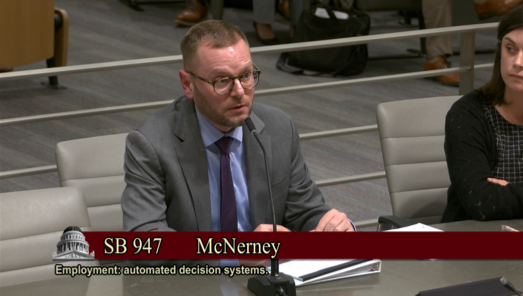
SB 947 (McNerney) adds restrictions to employers’ use of Automated Decision Systems (ADS) for disciplining, deactivating, or terminating an employee. This bill requires employers that primarily rely on ADS for these decision-making purposes to appoint a human reviewer to investigate and compile supporting evidence for the decision. This bill provides an employee with the right to request, and requires an employer to provide, a copy of the most recent 12 months of the worker’s own data primarily used by an ADS to make a disciplinary, termination, or deactivation decision. A worker is limited to one request every 12 months for a copy of their own data used by an ADS to make a disciplinary, termination, or deactivation decision. This bill requires employers primarily relying on ADS to make a disciple, deactivation, or termination decision to provide a post-use notice, as specified.
Please click here to view the SB 947 coalition letter that went to committee.
On a second measure, SB 951 (Reyes) Employment: technological displacement: notice, CSDA was on record with an Oppose Unless Amended position in the Senate Privacy, Digital Technologies, and Consumer Protection Committee on April 20. The final results were 7 Ayes, 2 Noes, and zero Abstentions with a do pass motion referred to Senate Appropriations Committee, where it will be heard on May 4.
SB 951 (Reyes) requires an employer to provide a specified 90-day written notice in advance of using technology that would displace or terminate 25 or more employees or 25% of the workforce. Specified written notice is also required in connection with adoption of AI or automated technology that reduces or ceases employers’ hiring, as specified. This bill grants employees of employers with over 100 employees the opportunity to apply first in other positions of the company/organization if affected by technology displacement or termination. Employers who fail to provide notice within the allotted time frame are liable for employee back pay and cost of any benefits.
Please click here to view the SB 951 coalition letter that went to committee.
AB 1883 (Bryan) Workplace surveillance tools was heard in the Assembly Privacy and Consumer Protection Committee held on April 16 with CSDA on record to oppose the measure. The committee voted 11 Ayes, 2 Noes, and 2 Abstentions passing the bill with a referral to Assembly Appropriations Committee, which is set to hear the measure April 29.
AB 1883 (Bryan) prohibits an employer from utilizing workplace surveillance technology that collects specified emotional, facial recognition, gait, and neural data. Given the broad definition of workplace surveillance technology, this bill could hinder the use of routine equipment for security, daily operations, or public health.
Please click here to view the AB 1883 coalition letter that went to committee.
CSDA is still fighting in opposition to AB 1898 (Schultz) Workplace artificial intelligence tools, which was heard in the Assembly Privacy and Consumer Protection Committee on March 25, receiving 10 Ayes, 3 Noes, and 2 Abstentions. The measure was referred to the Assembly Appropriations Committee and will be heard on April 29.
AB 1898 (Schultz) requires public agencies to provide written notice to employees, exclusive representatives, and independent contractors, regarding the use of a workplace AI tool, defined as an automated decision system (ADS) or workplace surveillance tool that uses AI. The notification must include burdensome, detailed prescribed information on the use of the technology. The requirements of the measure put the use of routine tools at risk. Disclosing such detailed information could put local agencies’ cybersecurity at risk and leave the public and employees vulnerable. Employee signatures of acknowledgement and understanding are required for the notices. This measure was highlighted in Legislative Office Visits during Special Districts Legislative Days 2026.
Please click here to view the AB 1898 coalition letter that went to committee.
AB 2027 (Ward) Worker data: prohibitions: artificial intelligence was heard in the Assembly Privacy and Consumer Protection Committee on April 21 with CSDA on record opposing the measure. The committee results were 10 Ayes, 3 Noes, and 2 Abstentions with the motion do pass and re-refer to the Assembly Appropriations Committee.
AB 2027 (Ward) provides that an employer shall not use a worker’s personal information to train an artificial intelligence system to replicate, automate, or replace a worker’s job. The bill would leave significant questions about whether agencies can use AI systems or how they could train them to perform their tasks. This measure was highlighted in Legislative Office Visits during Special Districts Legislative Days 2026.
Please click here to view the AB 2027 coalition letter that went to committee.
CSDA also opposed AB 2656 (Petrie-Norris) Public employees: notice: artificial intelligence performing service within scope of work in the Assembly Public Employment and Retirement Committee held on April 22. The motion was “do pass” and referred to the Assembly Appropriations Committee with 7 Ayes, zero Noes, and zero Abstentions.
AB 2656 (Petrie-Norris) requires a public employer to provide a recognized employee organization no less than 45 days’ written notice before taking an action to develop, purchase, implement, or utilize any generative artificial intelligence to perform a service that is within the scope of work of the job classification represented by the recognized employee organization.
Please click here to view the AB 2656 coalition letter that went to committee.
Stay tuned to CSDA eNews and Advocacy News for more information.
#AdvocacyNews#FeatureNews#LaborRelations#Advocacy