@Brittney Barsotti
- April 17 deadline rapidly approaching to comment on CARB mandate on local agencies’ to purchase only ZEV medium-duty and heavy-duty vehicles.
- Special district leaders brief media on how CARB truck ban would severely hinder emergency readiness, using real-life examples from recent events.
- CalTrans releases report detailing the extraordinary costs and operational deficiencies of CARB’s truck ban.
On Thursday April 9, 2026, CSDA hosted a press briefing with four special district general managers who provided clear examples of the troubling consequences the California Air Resources Board’s (CARB) Advanced Clean Fleets (ACF) regulations will impose on the communities they serve. Those ACF regulations are open to comment from local agencies, stakeholders, and the public until Friday, April 17.
Access Tools to Take Action on CARB Truck Regulations
During the 40-minute CSDA press briefing, panelists shared their experiences responding to some of California’s recent catastrophic wildfires and how CARB’s regulations would have dramatically hampered their ability to respond to the already-trying emergencies, making the destruction and loss of life even more tragic.
“What this translates to for our agency is over our 48 square mile service area, only seven vehicles would be allowed to be utilized for emergency response. That’s seven emergency response vehicles, 27,000 connections, 9,600 valves, 3,500 fire hydrants, 534 miles of pipeline, 12 reservoirs, and 2 treatment plants over 48 square miles… in a power outage. That is not tenable,” said Kimberly Thorner, Esq. General Manager of the Olivenhain Municipal Water District.
CSDA continues advocating for CARB to exclude vehicles that support emergency response services from its ACF regulations to ensure local agencies can respond to situations created by the very climate changes the regulations are designed to help address. Recent changes by CARB acknowledged some concerns raised by CSDA but, unfortunately, have not resolved them. CSDA led a coalition of local government organizations in submitting a 15-Day Comment Period Letter to CARB today.CSDA led a coalition of local government organizations in submitting a 15-Day Comment Period Letter to CARB today.
READ: CSDA-Led Coalition 15-Day Comment Letter
CalTrans Report Details Cost and Limitations from ACF Regulation
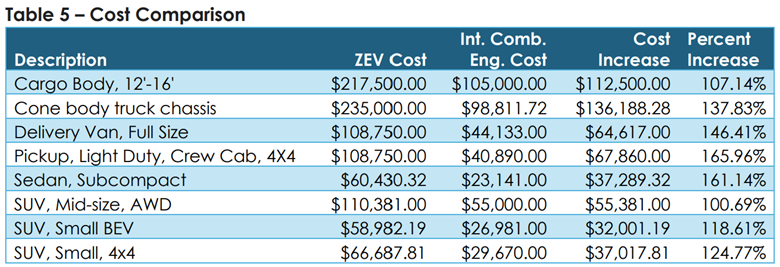
Also on Thursday April 9, CalTrans released a report shedding light on the hard costs of the ACF regulation. CalTrans owns over 12,000 vehicles. Its report details how the agency has spent state funds to begin converting its fleet to ZEV in an effort to comply with the CARB ACF regulations, highlighting the increased costs, delayed delivery times, and operational limitations of compliant vehicles. According to the report, “BEVs [Battery Electric Vehicles] remain significantly more expensive than their internal combustion engine counterparts, averaging 132.82 percent higher in purchase cost..” That’s more than double.
Notably, since 2022, Caltrans has only acquired 14 vehicles in 2022-23FY and 13 in 2024-25 ZEVs vehicles that are Class 3 and above, demonstrating the lack of availability and functionality of heavy-duty vehicles.
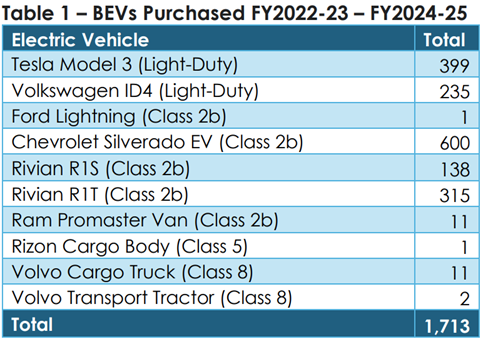
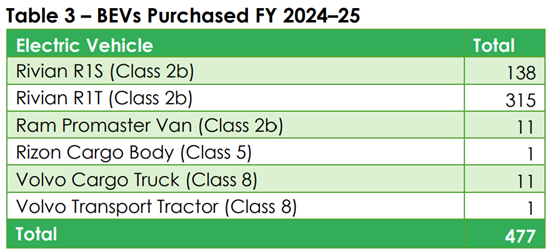
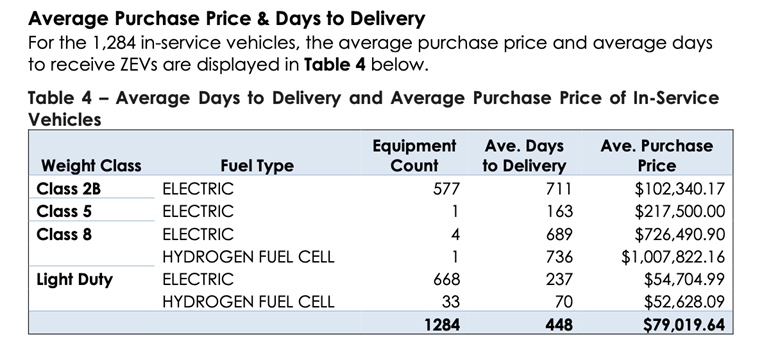
The vast majority of vehicles purchased by CalTrans (1,278 of the 1,713 vehicles purchased) ranged from light-duty (passenger vehicles) to Class 2b vehicles. Its report shows that 453 of the 477 vehicles it purchased in the 2024-25 FY were Rivians, which many residents consider luxury vehicles. Of the 577 Class 2b ZEVs CalTrans has in service, they cost an average of $102,340.17 each and delivery took an average of 711 days—nearly two years.
CalTrans purchased a limited number of vehicles above Class 2b, paying $217,500 for a Class 5 ZEV, an average of $726,490.90 for each of its four Class 8 electric vehicles, and over $1 million dollars for one class 8 hydrogen fueled vehicle.
The report also highlighted that over the past 3 years, installing a charging stations to fuel the vehicles cost $116,146 and took 1.9 years to finish, while charger replacement projects cost an average of $39,930 with an average duration of 1.8 years to complete. CalTrans estimates future projects will each cost $210,231 and take up to 3 years to complete. This data spotlights how expensive it is to build infrastructure to support ZEVs and underscores that state and local governments would need to start permitting and planning years in advance to install the infrastructure necessary to charge these vehicles..
Further complicating the infrastructure conundrum is that the limited exemptions the CARB ACF regulation offers must be requested and approved on an annual basis, making it impossible to effectively plan multiple years ahead for necessary infrastructure.
Notably the CalTrans report states, “A significant range disparity exists between ZEV and ICE Class 3 through Class 6 vehicles available today. On average, ZEV options in these classes have a driving range of between 100 and 190 miles. In comparison to their ICE vehicle counterparts this equates to roughly 50 percent less driving range. For most duty cycles, this translates to a need for a 2:1 ratio of ZEVs to ICE vehicles.” meaning state and local agencies will effectively need two ZEVs for every gasoline or diesel-powered vehicle in their current fleet.
Additionally, the Class 5 CalTrans ZEVs requires three batteries for the limited range, and Caltrans reports it had to work with manufacturers to redesign vehicles so they could perform their tasks with the batteries attached.
Beyond the cost, lack of infrastructure to charge ZEVs, and additional obstacles to purchaseZEVs, the CalTrans report also notes the drastically reduced capabilities of ZEVs and the consequence in terms of operational productivity. According to the report, even “under favorable conditions, their [ZEV] usable operational time does not align with standard shift hours.”
The report continues: “To meet service expectations without delays or reduced route completion, a two to three vehicle rotation is required: one (1) sweeper in active service, one (1) charging, and/or one (1) standing by to fill in as needed; this depends on operations for a 12-hour shift or a 24-hour shift.”
For Class 8 vehicles required for transporting construction equipment, the operational range is as little as 150-200 miles, compared to 750 miles for internal combustion engines, and requires 60 to 120 minutes of fast-charging (an option that is rare on transportation corridors) to recharge. To this point, Caltrans stated, “current operations cannot sustain extended downtimes or inefficient routing,” And, “to match the workload of one diesel vehicle it would take three BEVs [battery electric vehicles] rotated to allow transport, charging, and standby availability.”
Exemptions are Inadequate and Exceedingly Cumbersome
In acknowledgment of many of the concerns outlined by CSDA and other local agency organizations, CARB has proposed numerous exemptions to its ACF regulation. Unfortunately, they are both administratively burdensome and grossly insufficient to meeting communities’ service demands let alone the extreme conditions of a natural disaster.
Specifically, CARB’s proposed ACF exemptions require local agencies to annually apply and request approval from the CARB executive officer for exemptions on a case-by-case, vehicle-by-vehicle basis. Each exemption requires myriad paperwork or complex calculations spread in different sections of the regulations.
In recognition that ZEV medium-duty and heavy-duty vehicles are less resilient than internal combustion engine vehicles, CARB created a “resiliency” exemption. However, it tied the exemption to numerous pre-requisites and limitations. Most concerning, even if agencies were able to navigate the CARB exemption process the regulation caps exemptions at 25 percent of an agencies fleet. As the general managers participating in CSDA’s April 9 press briefing shared, during an emergency, local agencies need 125 percent of their fleet, not 25 percent. By capping local agencies’ resiliency, CARB is tying their hands and placing the communities they serve at risk.
ACF Cost is Unbearable for Both Local Agency Budgets and Emergency Readiness
Special district experts speaking on CSDA’s April 9 press briefing shared their extensive experience responding to emergencies. Each of them made clear that lives and property would be put at risk without their entire fleets prepared to deploy with adequate capabilities and run-times. Moreover, speakers emphasized that there is no time in an emergency to wait for vehicles to charge (assuming the power is even on). Moreover, local agencies cannot afford buying, maintaining, and storing an additional one or two vehicles for every current internal combustion engine vehicle in their fleet—especially when the ZEV counterpart can cost more than twice the amount of the vehicle it is replacing.
“When the regulations first came about, we had to ask for a waiver for a vehicle that we needed—a utility truck to bring a generator to one of our more remote well sites. The response from CARB was to ‘get a van, a passenger van.’ A van is not an equivalent replacement. It does not have the payload capacity, the configuration, or the safety features required for this type of work,” said Melanie Mow Schumacher of Soquel Water District.
“We support the climate change goals, and we still want to be a unified force in protecting public health,” said Mow Schumacher But we cannot do that effectively if we are forced to these impractical and unaffordable solutions.”
15-Day Period to Take Action Ends April 17
The CARB ACF regulation on medium-duty and heavy-duty vehicles is only open for a 15-day public comment period that ends Friday, April 17. Special districts are encouraged to submit public comment, as well as to share their story regarding the implications of the regulation with their stakeholders and community so that the public is afforded an opportunity to understand and weigh-in on this critical decision affecting their health and safety, as well as their finances.
In addition to submitting public comment, like and share social media posts by @CSDAdistricts or download our sample social media graphics and text for direct posts by you or your district. Traditional media is also interested in your story. Reach out to your local reporter to share what your agency is up against. Last week, the San Diego Union Tribune published an editorial by Olivenhain Municipal Water District General Manager Kimberly Thorner. CSDA members have also been quoted in recent articles by Gold Mountain California News and Red Bluff Daily News.
CSDA has established a fully-loaded Take Action webpage at csda.net/zev-flexibility to equip special districts, their partners, and the public with the resources they need to take action:
- Submit Public Comment to CARB
- Sample Comment Letter
- Download Proposed Amendments
- Sample Social Media Graphics and Text
- Public Polling Data
- CSDA Press Release
- Visit CARB ACF Regulation Webpage
If you need help accessing CSDA’s resources, connecting with your local media, or otherwise navigating questions on how to take action during this CARB 15-day comment period, please do not hesitate to contact your CSDA Public Affairs Field Coordinator.
#AdvocacyNews
#FeatureNews
#EnvironmentandDisasterPreparedness
#Mandates
#PublicWorksandFacilities