By: @Brittney Barsotti
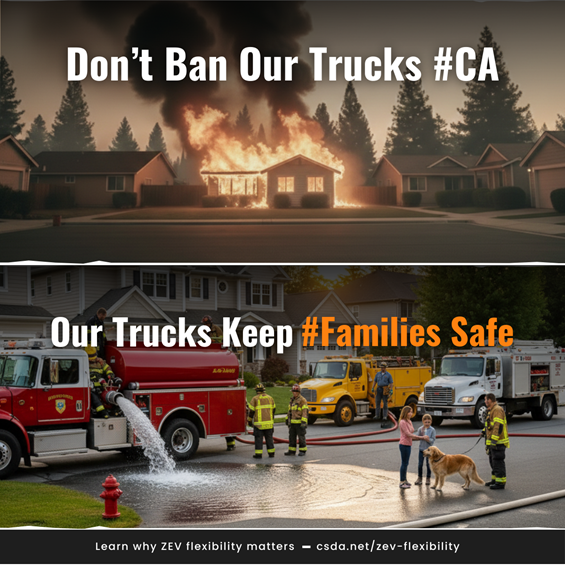
Download a sample letter you can submit to CARB urging the exclusion of all vehicles that support emergencies. Also, download graphics and sample social media posts.
On April 2nd the California Air Resource Board (CARB) posted their latest proposed amendments to their Advanced Clean Fleets (ACF) regulations, opening a new 15-day public comment window. Comments will only be accepted until April 17, 2026 at 5:00pm.
CARB’s 15-day amendments follow the previous 45-day comment period in September where CSDA and our partners requested amendments. CSDA is reiterating our request that vehicles that support emergency response need to be categorically excluded from the ACF regulation, which otherwise mandates all state and local government fleets of medium-duty and heavy-duty vehicles transition to zero emission vehicles (ZEV). ACF impacts vehicles Class 2b and above (8,500lbs gross vehicle weight and higher).
Key Take Aways from CARB’s 15-Day Comment Period Amendments:
- Allow fleet owners to switch between the purchase and milestone schedules if in compliance currently.
- All discretionary exemptions under the purchase schedule expire in 2030
- Exclude vehicle list (snow-removal, historical vehicles, etc.) remained unchanged-the only vehicles that will never be required to be ZEV under the regulations
- “Fleet Resiliency Exemption”
- Must have five percent of your fleet ZEV to qualify (Previously 25 percent)
- Exempt vehicles for “resiliency” cannot exceed the number of current ZEVs in fleet
- Total fleet exemptions must not exceed 25 percent, minus ICE vehicle already in the fleet purchased under a CARB exemption
- Delete Public Utility Vehicles definitions and provisions
- Define “Specialty Vehicles” as over 33,000 pounds that are stationary to perform their functions
- Add definitions and language addressing “waste fleets” and “wastewater fleets”
- Add provisions exempting vehicles using “captive biofuel”
CARB’s Limited Exemptions are Burdensome and Do Not Meet Community Needs
- Cap “resiliency” at 25 percent of fleets that are necessary to support emergency services
- The exemption process is cumbersome and disjointed with requirements scattered across a multitude of code sections
- All exemptions are left to the discretion of the CARB Executive Officer, who may use “good engineering judgment,” which is defined as “using commonly believed scientific and mathematical principles when making a decision that seeks to maximize public benefit and minimize public harm.”
- Includes exemptions for vehicles being unavailable and infrastructure delays, but these are still far too burdensome and require extensive documentation
- All exemptions require annual reapplication and re-approval from CARB
Emergency Response Vehicles Should Be Excluded from the ACF Mandate
Vehicles reasonably anticipated to respond to emergency situations, or that support those efforts, should be excluded from the regulations in the same manner as the current regulation excludes snow removal vehicles.
Some examples of vehicles called upon to preserve public health and safety beyond those currently exempted:
- Vehicles used for fire prevention/mitigation, public safety, search and rescue, medical response, and poacher prevention should be excluded.
- Vehicles that are essential to the delivery, repair, and maintenance of electricity, water, wastewater, stormwater, and flood protection should be excluded.
- Vehicles used to prevent and respond to the spread of disease and dangerous vector outbreaks should be excluded.
Visit csda.net/zev-flexibility today to learn more and access tools to help you and your community tell CARB: Don’t Ban our Trucks.
#EnvironmentResources
#Mandates
#PublicWorksandFacilities
#AdvocacyNews
#FeatureNews