By: @Aaron Avery
On October 16, CSDA and coalition partners submitted extensive comments to leaders of the California Public Employees’ Retirement System (CalPERS) in connection with CalPERS’ reinitiated rulemaking for its Regulation Defining Limited Duration for Post-Retirement Appointments.
The coalition comment letterfocused on achieving additional flexibilities in several key areas, including:
- Request for clarification of the standard for overlapping duties between prior and subsequent post-retirement appointments (i.e., “no duties overlapping” versus “vastly different duties”), as well as a request that the standard be “substantially different” and for a specialized skills exemption from that.
- Removal of a 12-month limitation after the conclusion of the first 24 months for the agency to do its next 12-month extension.
- A hardship exemption (with meaningful hurdles for an agency to get it) if the retired annuitant is still needed after 48 months. Currently, the CalPERS proposal is a 120 hour per year limit.
- Providing an opportunity for agencies to correct certain correctable violations as an alternative to automatic reinstatement for violations, and imposing a specified 3-year statute of limitations (absent certain factors).
The purpose of the rulemaking is to provide a definition of “limited duration” that includes restrictions on the duration for which CalPERS retired annuitants may work in retirement at a CalPERS-covered employer, which will generally be limited to 48 months in specified increments. This regulation is limited to the period of time constituting “limited duration,” not the number of hours that may be worked each year or other requirements for working in retirement.
CalPERS previously advanced its regulation in a 2022 rulemaking. (See CalPERS Adopts Revised Limited Duration Employment Regulations, Subject to 15-Day Comment Period). However, the regulatory process was halted prior to final adoption. Please check the CalPERS Regulatory Actions page, “Definition of Limited Duration Employment” tab, for more background on the 2022 rulemaking.
The reintroduced CalPERS regulation is still in the “pre-rulemaking” informal phase and CalPERS may commence formal rulemaking as early as November 2026. At this time, CalPERS has released the following documents for review by stakeholders:
- Summary of Proposed Regulation Defining Limited Duration for Post-Retirement Appointments
- Proposed Text: Definition of Limited Duration Employment
CalPERS has provided additional details about the proposal, and has stated that key provisions include:
Limited Duration
- Retirees can work in a post-retirement appointment for two years with the same employer.
- Extension Process: After two years, the employer can extend the appointment for two additional years by approving one-year extensions for each year. The employer’s governing body must approve each extension and certify specific requirements are met at a public meeting before the retiree can continue working in that position under the approved extensions.
- Exemption Process: After four years (end of the second extension), the employer’s governing body can approve an exemption for a 120 hour per year continuous extension. Under the exemption, the retiree cannot work more than 120 hours per fiscal year in that position and cannot have another concurrent appointment with an approved exemption with the same employer. The employer’s governing body must certify specific requirements are met at a public meeting before the retiree can continue working in that position under the approved exemption.
- If the employer’s governing body does not approve an exemption, then that appointment ends and the retiree cannot work in another post-retirement position with that same employer unless the duties for the new post-retirement position are vastly different than the duties of the previous post-retirement position. For example, a retiree works as a bus driver for four years, that appointment ends and the same school district hires the retiree to work as a food service worker. Those positions have vastly different duties from each other and the food service position would be considered a new appointment with the employer.
- For retirees working in post-retirement appointments prior to the regulation effective date, the two-year duration begins on the regulation effective date.
Employer Responsibilities
- It is the employer’s responsibility to certify that all requirements are met for extensions and exemptions.
- The employer must keep all extension and exemption resolutions (memorandums for state appointments) and provide those resolutions to CalPERS upon request during any future investigations or audits.
- The employer must report the retiree’s name and anticipated end date for each extension and any exemptions to CalPERS. CalPERS will include the retiree in its annual report of approved extensions and exemptions, which will be available on the CalPERS website.
- For appointments with the state, the California Department of Human Resources (CalHR) certifies all requirements are met for extensions and exemptions by memorandum. CalHR may establish a process to delegate the certification to individual state agencies and may audit the state agency’s extension and exemption process to determine if abuses of the system occur. If necessary, CalHR may assume a state agency’s certification authority for retirees. CalHR, under their existing authority, may charge state agencies for this service.
- For appointments with the California State University, the Trustees of the California State University certify all requirements are met for extensions and exemptions by resolution at a public meeting.
- For appointments with the legislature, the Senate Committee on Rules or the Assembly Rules Committee, as applicable, certifies all requirements are met for extensions and exemptions by resolution at a public meeting.
Collective Bargaining Agreements
- If a collective bargaining agreement explicitly sets a different duration, up to five years, that duration applies instead of the standard two years. In the collective bargaining agreement, only that negotiated term will apply. The two one-year extensions and the 120-hour exemption will NOT apply. The maximum time allowed will be up to five years only.
- Employers must notify CalPERS and provide a copy of the agreement.
- Retirees whose duration is set by a collective bargaining agreement cannot hold another post-retirement appointment with the same employer.
Compliance and Penalties
Violations by retired persons or employers are subject to applicable penalties under Government Code section 21202, 21220, and 7522.56.
This is a summary, not the full extent of requirements, and was provided by CalPERS. Special districts should review the proposed regulations with counsel to determine compliance obligations and impacts.
CalPERS has also provided the following chart of key differences between the 2022 and 2026 drafts:
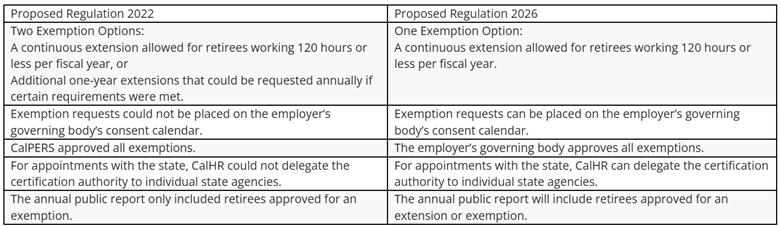
CalPERS has also provided stakeholders with a link to a Retired Annuitant Hiring Questionnaire: Retired Annuitant Hiring Questionnaire.
Stay tuned to Advocacy News and CSDA eNews for additional updates and opportunities to comment once formal rulemaking begins.
#AdvocacyNews#FeatureNews#GrassrootsNews#SpecialDistrictNews#HumanResources#HumanResourcesandPersonnel#PensionsandRetirement#IndependentContractors